Where Claims Actually Break Down Before the Payer Sees Them
A claim does not become problematic only when a payer rejects it.
In many cases, the conditions that lead to a rejection, denial, delayed payment, or unnecessary A/R work are created much earlier. A missing charge, incomplete documentation, incorrect modifier, expired authorization, or payer-specific requirement can introduce risk before the claim ever leaves the practice.
That makes claim quality a workflow issue, not simply a submission issue.
A strong medical billing operation looks beyond the final claim file. It examines how information moves from the patient’s coverage and clinical documentation through charge capture, coding, authorization, claim preparation, and clearinghouse review.
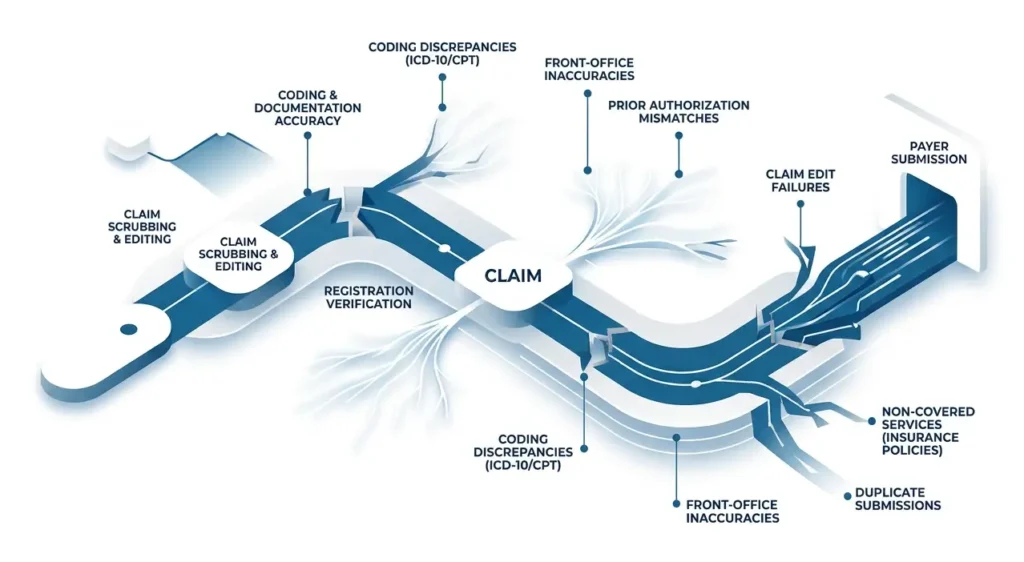
The Pre-Payer Claim Chain
A medical claim passes through several connected stages before reaching the payer:
Every handoff creates an opportunity for information to become incomplete, inconsistent, outdated, or disconnected from the service being billed.
The earlier a problem enters the process, the more likely it is to create rework later.
1. Charge Capture Starts the Chain
Before a claim can be coded or submitted, the services provided must be captured accurately.
This sounds straightforward, but charge capture can become a source of revenue leakage when information is incomplete or does not move into the billing workflow correctly.
Common problems include:
- Services that were performed but never entered for billing
- Duplicate charges
- Incorrect service dates
- Incorrect units
- Charges entered under the wrong provider or location
- Delayed charge entry
- Services that do not match the supporting documentation
A missing charge can be particularly difficult to identify because there may be no claim error to review. The claim was never created in the first place.
This is why charge reconciliation matters. Billing teams need a way to compare the services documented or recorded in the practice workflow against what ultimately enters the billing process.
2. Documentation Doesn’t Fully Support the Charge
Coding cannot compensate for missing or incomplete documentation.
The clinical record provides the context needed to determine what service was performed, why it was performed, and whether the documentation supports the code selected for billing.
When documentation does not adequately support the service, several problems can follow:
- The coder may need clarification before assigning a code.
- The service may require a different code than initially expected.
- A modifier may not be supported.
- Medical necessity may become difficult to establish.
- Additional review may be required before submission.
The issue is not simply whether documentation exists. The more important question is whether the documentation supports the specific service, code, units, and circumstances represented
on the claim.
That distinction becomes even more important in specialties where documentation and coding
requirements vary significantly.
3. Coding Decisions Create Downstream Risk
Coding is one of the most visible parts of claim preparation, but coding risk is rarely limited to
selecting the wrong code.
CPT®, HCPCS Level II, and ICD-10-CM coding decisions interact with documentation, payer policies, modifiers, units, bundling edits, and the services actually performed.
Potential problems include:
- An unsupported or inappropriate modifier
- Incorrect units
- Inconsistent diagnosis and procedure information
- Coding that does not reflect the documented service
- Bundling issues
- Missing codes required to represent the service accurately
- Specialty-specific coding considerations being overlooked
A claim can therefore contain a technically valid code and still require additional review.
The relevant question is not simply:
“Is this code correct?”
It is:
“Does the complete claim accurately represent the service, documentation, coding requirements, and payer expectations?”
That broader review can identify problems that a basic code validation process may miss.
4. Eligibility Is Confirmed, but Coverage Isn’t Fully
Understood
Eligibility verification is essential, but an active insurance policy does not automatically mean
that every service is covered.
Coverage can depend on factors such as:
- Benefit limitations
- Network participation
- Service-specific coverage
- Patient responsibility
- Referral requirements
- Medical necessity
- Prior authorization
- Payer-specific policies
A patient’s insurance can therefore be active while a particular service still carries restrictions or additional requirements.
This is one reason eligibility should not be treated as a simple active/inactive checkpoint.
The billing workflow needs enough information to determine whether the planned or completed service can move forward under the patient’s specific coverage conditions.
5. Authorization Information Doesn’t Follow the Claim
Prior authorization creates another potential break in the chain.
An authorization may have been obtained correctly, yet the claim can still encounter problems if the authorization details do not align with the billed service.
For example, the billing team may need to verify:
- Whether authorization was required
- Whether the authorization was obtained
- Whether it was still valid on the date of service
- Whether the approved service matches the billed service
- Whether the approved number of units or visits has been exceeded
- Whether the authorization information is available during claim preparation
An authorization number by itself does not guarantee payment.
The authorization must correspond to the service, patient, payer, dates, and other applicable conditions represented in the billing workflow.
This is why authorization should not operate as an isolated administrative task. Its information needs to remain connected to the claim throughout the revenue cycle.
6. Payer Requirements Are Missed Before Submission
Medical claims do not move through one universal payer environment.
Medicare, Medicaid, and commercial health plans can apply different coverage policies, edits, documentation requirements, medical necessity criteria, and reimbursement rules.
A workflow that treats every payer the same can therefore create avoidable problems.
Payer-related risks may include:
- Payer-specific claim edits
- Coverage restrictions
- Medical necessity requirements
- Documentation requirements
- Coding policies
- Submission requirements
- Service-specific reimbursement rules
The challenge is not simply knowing that payer rules exist.
The challenge is incorporating relevant payer requirements into the workflow before the claim is submitted.
That requires billing teams to maintain current payer knowledge and apply it at the appropriate point in the process.
7. EMR/EHR Handoffs Create Data Gaps
The EMR or EHR may contain the information needed to support a claim, but having access to the clinical system does not automatically create a clean billing workflow.
Information moves through several operational stages:
At each handoff, information can be incomplete, inconsistent, delayed, or mapped incorrectly.
Examples include:
- Provider information not transferring correctly
- Service details requiring manual clarification
- Diagnosis information not flowing as expected
- Incorrect location or date information
- Missing authorization details
- Charges remaining unbilled because of workflow exceptions
This is why EMR/EHR connectivity should be evaluated as part of the entire revenue cycle, not simply as a technology integration.
The objective is not just moving data between systems. It is maintaining the accuracy and usefulness of that information as it moves toward claim submission.
8. The Clearinghouse Is Not the Final Quality Check
A clearinghouse can perform valuable validation before a claim reaches the payer. But clearinghouse acceptance should not be confused with payer acceptance.
There are several different outcomes:
Accepted by the clearinghouse
The claim passed the clearinghouse’s applicable validation checks.
Accepted by the payer
The payer received and accepted the claim into its adjudication process.
Adjudicated
The payer processed the claim according to its policies and coverage rules.
Paid
The claim resulted in reimbursement.
These are not interchangeable.
A claim can pass clearinghouse validation and still be rejected or denied by the payer because of payer-specific requirements, coverage policies, medical necessity, authorization, coding, or other adjudication factors.
That distinction is critical when evaluating claim performance.
9. Final Claim Review Happens Too Late
Many billing operations treat claim review as the last checkpoint before submission.
That approach has limitations.
If a claim contains a problem created during documentation, charge capture, authorization, or coding, discovering it at the final review stage means the billing team has already inherited the consequences of an earlier workflow issue.
The better question is not:
“Did we catch the error before submission?”
It is:
“Where in the workflow did the condition that created this error originate?”
That shift changes how a billing operation approaches quality.
Instead of repeatedly correcting the same claim-level problems, teams can identify recurring patterns and determine whether the underlying workflow needs to change.
For example, repeated authorization-related denials may indicate more than an issue with individual claims. They may point to a breakdown in how authorization information is captured, monitored, or transferred into billing.
Likewise, recurring modifier problems may suggest a need to review coding workflows, documentation practices, or specialty-specific billing guidance.
What a Strong Pre-Payer Review Looks For
A useful pre-submission process does more than search for obvious claim errors.
It considers whether the information coming together on the claim is complete, consistent,
supported, and appropriate for the payer receiving it.
Depending on the specialty and service, that review may consider:
- Patient and insurance information
- Provider and location details
- Charge information
- CPT®, HCPCS Level II, and ICD-10-CM coding
- Modifiers and units
- Documentation support
- Eligibility and coverage considerations
- Authorization requirements
- Payer-specific rules
- Claim-level edits
- EMR/EHR data consistency
Not every claim requires the same level of intervention. The goal is not to create unnecessary manual work.
The goal is to identify the claims and circumstances where additional attention can prevent downstream rework, rejection, denial, or delayed reimbursement.
The Bigger Problem Is Often the Workflow, Not the Claim
A single rejected claim is easy to focus on.
A pattern of similar rejected claims is more valuable because it provides information about the billing operation itself.
If the same issue appears repeatedly, the question should move beyond:
“How do we fix this claim?”
and toward:
“Why does this keep happening?”
That can lead to deeper operational questions:
- Is the required information being captured at the right point?
- Is documentation reaching the billing team in usable form?
- Are coding rules being applied consistently?
- Are authorization requirements being tracked?
- Are payer changes reaching the people responsible for claim preparation?
- Are EMR/EHR workflows creating recurring data gaps?
- Are the same errors appearing across a particular specialty, provider, location, or payer?
This is where claim quality becomes more than a billing metric.
It becomes a source of operational intelligence.
A Clean Claim Is Built Before It Is Submitted
The strongest claim is not necessarily the one that survives a final scrub.
It is the one built from accurate information at every stage leading up to submission.
That means claim quality begins with the patient’s coverage and clinical documentation. It continues through charge capture, coding, authorization, payer-specific requirements, system handoffs, and final claim preparation.
By the time a claim reaches the clearinghouse, most of the important decisions have already been made.
A billing operation that understands this can move beyond simply processing claims. It can identify where problems originate, recognize recurring patterns, and strengthen the workflows responsible for producing clean claims in the first place.
The payer may make the final decision on a claim, but the quality of that claim is largely shaped long before the payer sees it.
Want to Strengthen the Workflow Behind Your Claims?
See Where Better Billing Operations Can Make a Difference
Claim quality starts well before submission. If you’re looking for a more connected approach to coding, payer requirements, authorization, claims, denials, and revenue cycle management, let’s discuss your practice and its billing environment.