

Urgent Care Billing Services Designed for High-Volume, Same-Day Care
Keep billing moving at the pace of urgent care
Medverse combines intelligent billing technology with experienced human oversight to manage the revenue cycle behind urgent care encounters. AI helps identify issues, patterns, and work that needs attention, while billing specialists apply the judgment needed across charge capture, coding, claim submission, denials, and A/R. The result is a connected billing operation that can keep pace with your practice, whether you operate a single center or multiple locations.

Operating in Alignment With Today's Healthcare Billing Standards
✓ HIPAA ✓ CMS ✓ AMA CPT® ✓ ICD-10-CM ✓ HCPCS Level II ✓ No Surprises Act
The Revenue Cycle Starts at the Front Desk
The information captured before the visit moves forward can shape everything that follows
In urgent care, the financial side of an encounter begins before the patient sees a provider. Effective billing services need to account for what happens at registration, during eligibility verification, and throughout the front-end workflow. Small front-end errors can multiply quickly when the same process is repeated across hundreds or thousands of encounters.
Patient Registration
Capture complete and accurate patient information at check-in, including demographics and contact details needed for the billing workflow.
Insurance Verification
Confirm the patient's insurance information and identify coverage details that could affect how the encounter is billed.
Eligibility Review
Verify active coverage and identify changes, limitations, or eligibility issues before they become claim or patient-balance problems.
Financial Responsibility
Review copays, deductibles, and applicable benefit information so patient responsibility is reflected appropriately.
Provider & Location Details
Keep rendering provider, billing provider, and service-location information aligned with the encounter and the claim that follows.
Charge Capture
Capture the services performed during the visit accurately so the clinical encounter can move into coding and billing without missing revenue.
AI Starts Working Before the Claim Reaches the Payer
Intelligent technology helps billing teams keep up with the pace and volume of urgent care
AI can work across the billing workflow to identify information that needs attention, recognize patterns across large volumes of activity, and help teams focus their time where it can have the greatest impact. Instead of waiting for problems to surface after claims are submitted, Medverse uses AI to help billing specialists identify potential issues earlier and review high-volume work more efficiently.
Where AI Adds Value

Incomplete or Inconsistent Information
Identify missing, conflicting, or unusual information that may require review before it creates downstream billing issues.

Claims Requiring Attention
Flag claims and billing activity that contain exceptions or characteristics that warrant closer review.

Recurring Billing Patterns
Surface repeated issues across claims, services, payers, locations, or other areas of the billing workflow.

Work Prioritization
Help teams prioritize outstanding work based on potential financial impact, urgency, and the type of intervention required.

High-Volume Workflow Monitoring
Monitor large volumes of billing activity and help identify exceptions that could otherwise be difficult to spot manually.

Human Review Where It Matters
AI surfaces information and patterns, while experienced billing specialists evaluate the circumstances and make decisions that require professional judgment.
The goal is not to replace the people managing the revenue cycle. It is to support smarter billing solutions that help teams process more information, identify issues sooner, and direct their attention to the work that matters most.
Put AI to Work Across Your Billing Workflow
Use intelligent technology to identify issues sooner and help your team focus on the work that matters most
See how Medverse combines AI-enabled billing workflows with experienced human review to manage high-volume urgent care billing more efficiently.
From the Urgent Care Encounter to the Claim
One urgent care visit can involve several services, decisions, and billing steps before payment ever reaches the practice
Urgent care billing services have to preserve what actually happened during the encounter and carry that information accurately from the front desk to the payer. Medverse connects each stage so that services are captured, documented, coded, submitted, and followed through without losing important details along the way.
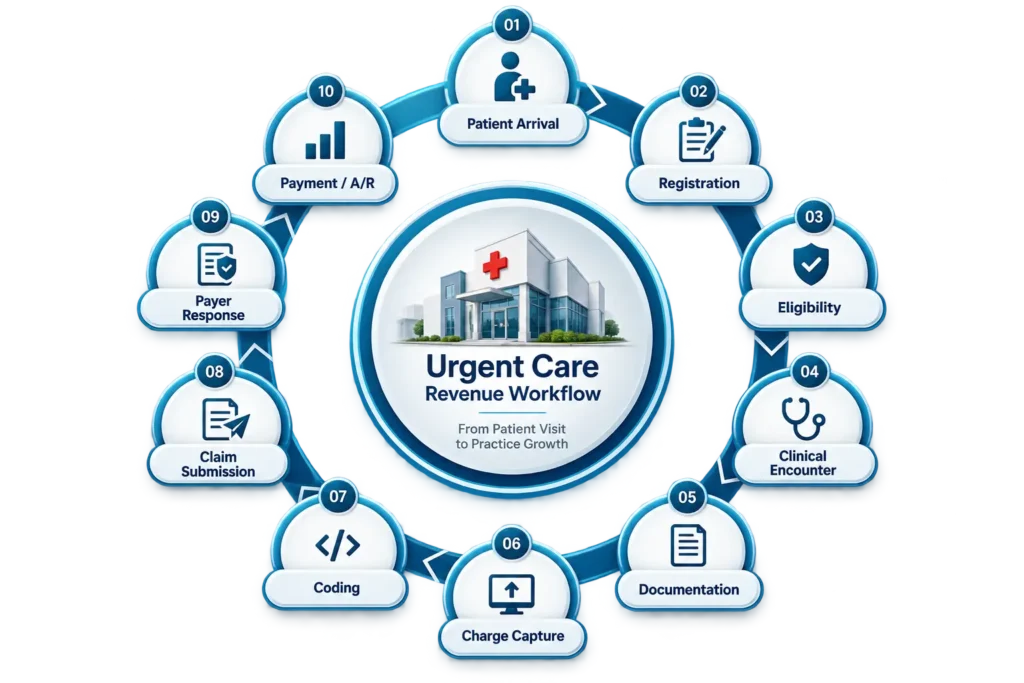
The Urgent Care Revenue Workflow
01 ⸻⸻ Patient Arrival
02 ⸻⸻ Registration
03 ⸻⸻ Eligibility
04 ⸻⸻ Clinical Encounter
05 ⸻⸻ Documentation
06 ⸻⸻ Charge Capture
07 ⸻⸻ Coding
08 ⸻⸻ Claim Submission
09 ⸻⸻ Payer Response
10 ⸻⸻ Payment / A/R
One Encounter, Multiple Billing Events
Depending on the care provided, an urgent care encounter may include:
- E/M Services
- Minor Procedures
- Diagnostic Testing
- Imaging
- Laboratory Services
- Injections & Medications
- Splinting & Wound Care
- Point-of-Care Testing
- Occupational Health Services, Where Applicable
The objective is not simply to move a claim through the system. It is to make sure the services actually performed are accurately represented in the billing record, supported by the documentation, and carried through coding and claim submission correctly.
Coding Has to Reflect the Encounter, Not Just the Diagnosis
Accurate coding starts with the full picture of what was documented, performed, and billed.
An urgent care visit may involve an evaluation, procedure, diagnostic testing, medication administration, or several services during one encounter. Within urgent care billing, coding review has to consider how those services relate to one another, what the documentation supports, and what the payer requires before the claim moves forward.
E/M Coding Based on the Documented Encounter
For office and other outpatient E/M services, coding review considers the documented medical decision making or applicable time requirements to support the appropriate level, including relevant 99202 99205 and 99211–99215 code families. The selected level should reflect the work supported by the record, not simply the complexity of the diagnosis.
Diagnosis-to-Service Linkage
The documented condition, symptoms, findings, or reason for service should appropriately support the procedure or diagnostic service reported. This becomes particularly important when multiple services with different clinical indications are billed from one encounter.
Procedures and Diagnostic Services
Coding review covers CPT® and HCPCS Level II reporting for procedures, laboratory testing, imaging, injections, wound care, splinting, specimen collection, and other services performed during the visit. The review confirms that reported codes represent the services performed and are supported by the documentation.
Documentation and Medical Necessity
The clinical record is reviewed to confirm that documentation supports the reported services and contains the required elements. Diagnosis coding and documentation are also evaluated against applicable medical-necessity requirements.
Modifier and Bundling Review
Modifier requirements are evaluated, including modifier 25 when a significant, separately identifiable E/M service is appropriately reported with another service. Applicable NCCI edits and modifiers such as 59, XE, XP, XS, and XU are also reviewed against the actual circumstances of the encounter.
Payer-Specific Requirements
Payer-specific edits, coverage policies, medical necessity rules, authorization requirements, and reporting requirements are considered alongside CPT®, HCPCS Level II, ICD-10-CM, and NCCI guidelines.
What the Review Is Designed to Catch
✓ E/M level discrepancies
✓ Unsupported or missing modifiers
✓ Bundling and NCCI conflicts
✓ Incomplete documentation
✓ Diagnosis-to-service mismatches
✓ Payer-specific claim edits
✓ Medical-necessity concerns
✓ Services that may be missing from the claim
The goal is not simply to assign the right code. It is to make sure the claim accurately represents what happened during the
encounter, what the documentation supports, and what the applicable billing requirements allow.
Numbers Behind the Billing Operation
Measured across the billing work that matters to healthcare practices
Our performance reflects the scale, accuracy, and consistency of the billing operations Medverse manages across its healthcare clients.
Faster Reimbursements
Claims Submitted Within 48 Hours
Eligibility Verification Rate
First-Pass Claim Acceptance Rate
See What Better Billing Performance Could Mean for Your Urgent Care Practice
A closer look at your current workflow can reveal where claims slow down, work accumulates, or revenue gets delayed.
Review your billing operation with a team that understands high-volume urgent care workflows.
When Volume Goes Up, Small Billing Problems Multiply
In urgent care, even a small amount of billing friction can become significant when repeated across a high volume of encounters
A busy urgent care center processes a continuous flow of registrations, eligibility checks, clinical encounters, claims, payer activity, and patient balances. As volume increases, small issues can repeat often enough to create a meaningful financial and operational burden.
More Volume Creates More Points of Exposure
More Encounters
More Claims
More Payer Responses & Denials
More Eligibility Problems
More Patient Balances
More A/R Activity
Small Percentages Can Become Large Numbers
A billing issue does not have to affect a large percentage of claims to matter. When the same problem is repeated across thousands of encounters, a small error rate can turn into a significant financial and operational issue.
That is why high-volume urgent care billing requires more than simply processing claims. It requires visibility into where problems are occurring, how often they repeat, and where action is needed before the workload continues to build.
Denials Need to Be Read as Patterns
A denial is not only a claim that needs correction. It can also signal a recurring problem within the billing workflow.
With high urgent care claim volume, reviewing denials collectively can reveal patterns that are difficult to recognize claim by claim. Medverse looks across payers, locations, providers, services, and denial reasons to identify where recurring issues may be developing.
What Is the Denial Data Telling You?
Is the Same Payer Rejecting the Same Service?
Recurring payer denials may point to specific billing, coverage, coding, or documentation requirements.
Are Certain Locations Producing More Eligibility-Related Denials?
Higher denial activity at one location may indicate differences in registration or insurance verification workflows.
Are Specific Procedures Generating Recurring Edits?
Repeated edits can signal coding, modifier, bundling, documentation, or payer-specific issues.
Are Documentation Issues Appearing Repeatedly?
Similar documentation-related denials may indicate a process issue that extends beyond individual claims.
Are Certain Providers or Service Categories Showing Unusual Trends?
Comparing denial activity can reveal variations that may otherwise remain hidden within overall claim volume.
Turning Denial Activity Into Action
Medverse uses AI-enabled analysis to help surface recurring patterns across large volumes of billing data. Billing specialists then review the underlying circumstances and determine the appropriate response.
The goal is not simply to work through denials. It is to understand why they keep occurring and address the problems behind them.
Billing Intelligence That Helps Your Team Prioritize the Right Work
Not every outstanding billing issue carries the same financial impact or requires the same level of attention
A high-volume urgent care operation can have thousands of claims, open A/R accounts, payer responses, and unresolved tasks moving through the revenue cycle at the same time. The challenge is knowing where attention can make the greatest difference.

See the Revenue Cycle Beyond the Claim
Medverse combines billing data, reporting, and AI-enabled analysis to help teams identify where work is building up and
which areas deserve closer attention.
- A/R Prioritization — Identify outstanding accounts that may require earlier or more focused follow-up.
- Denial Trends — Monitor recurring denial activity and changes across payers, services, and locations.
- Payer Performance — Compare payment activity, denial patterns, and unresolved claims across payers.
- Location-Level Patterns — See where billing performance or workflow issues vary between urgent care centers.
- Unresolved Claim Activity — Highlight claims and billing tasks that remain open or require intervention.
- Workflow Exceptions — Surface unusual activity that may warrant review before it becomes a larger operational issue.
- Revenue-Cycle Reporting — Bring key billing activity into reporting that helps teams understand performance and make informed decisions.
AI helps organize and surface the information. Billing specialists provide the context, judgment, and follow-through needed
to turn that information into action.
Turn Billing Data Into Better Priorities
Know where your revenue cycle needs attention, not just what is happening inside it
Use billing intelligence to understand performance, prioritize outstanding work, and focus your team's effort where it can have the greatest operational and financial impact.
Built for the Way Urgent Care Organizations Operate and Grow
Urgent care billing needs to remain consistent even as the organization, patient volume, and service footprint change
Medverse provides billing solutions for independent centers, physician-owned practices, group-operated organizations, and multi-location urgent care networks. Our urgent care billing services can adapt as your operation grows, adds providers, opens locations, or expands its services.
Built Around the Changes Your Practice Experiences
Day-to-Day Operations
Seasonal Volume
New Locations & Providers
Expanded Services & Scale
Consistency as the Organization Changes
Medverse provides the structure to support centralized oversight, location-level reporting, payer-specific requirements,
provider credentialing, and scalable billing workflows as urgent care operations evolve.
The objective is straightforward: your billing infrastructure should support growth, not become a constraint as the organi
zation changes.
What Your Team Should Be Able to See
Billing activity should be visible enough to show where revenue is slowing down, where work is accumulating, and where action is needed
A high-volume urgent care operation generates a constant stream of billing activity. Clear visibility helps your team under stand what is happening across claims, payers, A/R, locations, and other parts of the revenue cycle.
The Information Behind Better Decisions
Claims Status
Track submitted, pending, rejected, denied, and unresolved claims across the billing workflow.
Denial Trends
Monitor recurring denial activity and changes that may require investigation or corrective action.
A/R Aging
See where outstanding balances are concentrated and how long they have remained unresolved.
Payer Performance
Compare payment activity, denials, and outstanding claims across payers.
Collection Trends
Monitor collection activity over time and identify changes that may affect revenue performance.
Location-Level Performance
Compare billing activity and revenue-cycle performance across urgent care locations.
Coding Issues
Identify coding-related issues that may affect claim submission, reimbursement, or payment accuracy.
Authorization Activity
Maintain visibility into authorization requirements, pending activity, and issues that could delay claim movement.
Outstanding Work
Keep unresolved billing tasks visible so follow-up activity can be prioritized and tracked.
The objective is not simply to produce more reports. It is to give your team a clearer view of the revenue cycle and help them recognize where action can have the greatest impact.
Connected to the Systems Behind Your Urgent Care Workflow
Your billing operation should stay connected to the systems where patient, encounter, and charge information begins
Medverse builds billing solutions around the technology environments used by urgent care organizations, helping move relevant information from the clinical workflow into billing, claims, and reporting.
Connected Across the Revenue Cycle
EMR/EHR Connectivity
Support billing workflows across widely used EMR/EHR platforms and the systems your urgent care organization already relies on.
Encounter & Charge Data
Connect relevant encounter and charge information to the billing workflow for review, coding, and claim preparation.
Claim & Status Workflows
Keep claim submission, payer responses, rejections, denials, and other status information connected to the billing process.
Reporting & Visibility
Bring billing activity into reporting that helps your team monitor claims, A/R, denials, payments, and overall revenue-cycle performance.
Clinical-to-Billing Data Flow
Help maintain continuity between where care is documented and where revenue cycle work takes place.
EMR/EHR Systems We Work With
From encounter data to claims and reporting, the objective is to keep the systems behind your urgent care workflow connected to the billing operation.















Compliance Has to Move at the Same Speed as the Practice
Fast-moving urgent care operations still require billing processes that follow the rules governing how healthcare information, services, claims, and patient financial responsibility are handled.
Compliance is not a separate task that happens after billing work is complete. It needs to be considered throughout the revenue cycle, from documentation and coding through claim submission, payment, and patient billing.
Compliance Within the Billing Workflow





HIPAA
Protect patient information throughout billing, reporting, communication, and data-handling processes.
Payer Policies
Account for payer-specific coverage policies, claim requirements, medical-necessity rules, and applicable edits.
CMS Requirements
Apply applicable Medicare and Medicaid billing requirements, program rules, and reporting expectations.
Patient Financial Responsibility
Process copays, deductibles, coinsurance, and other patient responsibility in accordance with applicable requirements and payer information.
Coding & Documentation
Keep reported services aligned with clinical documentation and applicable coding requirements.
Federal & State Requirements
Consider applicable federal and state requirements that affect urgent care billing and patient financial processes.
Keep Compliance in the Workflow
Build billing processes that account for regulatory, coding, payer, and patient-financial requirements as work moves through the revenue cycle.
What Medverse Can Take Off Your Team's Plate
Urgent care billing involves more than getting claims out the door. Medverse can take responsibility for the connected work that keeps the revenue cycle moving from the front end through payment and reporting.
✓ Front-End Revenue Support
Help strengthen the processes that happen before a claim is created.
- Eligibility verification
- Registration-related billing workflows
- Authorization support where applicable
✓ Revenue Recovery
Keep attention on revenue that remains unresolved after claims are submitted.
- Denial management
- A/R follow-up
- Underpayment identification
- Payment posting
✓ Coding & Claims
Manage the work required to turn documented services into accurate, payer-ready claims.
- Charge review
- Medical coding
- Claim submission
- Claim scrubbing
- Payer edits
✓ Operational Visibility
Give your team the information needed to understand billing performance and identify where attention is required.
- Revenue-cycle reporting
- Trend analysis
- Performance monitoring
Whether you need support with a specific part of the revenue cycle or a more comprehensive billing operation, Medverse can align its billing solutions with the way your urgent care organization operates.
What Urgent Care Practices Say About Working With Medverse
Billing Support That Keeps Pace With the Demands of Urgent Care
Urgent care practices manage fluctuating patient volumes, varied clinical encounters, and a steady flow of insurance claims. A dependable billing partner needs to understand those demands while providing responsive communication, consistent follow-up, and clear visibility into outstanding revenue. The experiences below reflect what practice leaders value about working with Medverse.




“On a busy weekend we can see everything from respiratory complaints to minor injuries and laceration repairs. The coding needs aren't always straightforward, especially when procedures are involved. It's helpful to have a billing team that understands that variety.”
Dr. Megan Foster Medical Director, Walk-In Urgent Care Center“We don't have the luxury of slowing down our front desk every time there's an insurance question. Medverse has helped us identify recurring registration and claim information problems so we can address them with the staff.”
Christina Bailey Clinic Operations Manager, Independent Urgent Care Practice“One of our biggest concerns was making sure the E/M coding reflected the documented visit and that separately reportable services were handled appropriately. The Medverse team has been easy to work with on those questions.”
Dr. Nicholas Turner Physician Owner, Urgent Care Clinic“With multiple providers and a steady flow of walk-in patients, we need billing support that can manage volume and still pay attention to outstanding claims. Medverse has been a good operational fit for the way our centers run.”
Brittany Hughes Director of Administration, Multilocation Urgent Care GroupLet’s Look at What Happens After the Patient Leaves
A busy urgent care center can move hundreds of encounters through its doors while billing issues quietly accumulate behind the scenes. Our urgent care billing services are designed to help identify where those issues are occurring and where your revenue cycle needs attention. Tell us where your current revenue cycle needs attention, and we’ll explore the billing solutions that best fit your urgent care operation.
“Urgent care is a high-volume business, and small billing mistakes add up quickly. Medverse understands the pace we work at and the need to keep encounters moving without skipping the details that affect reimbursement.”
Travis Whitlock Regional Manager, Urgent Care Clinic Group