

Revenue Cycle Management Services That Connect the Work Behind Your Revenue
Patient Access. Claims. A/R. Reporting. One Connected Revenue Cycle.
Medverse provides end-to-end revenue cycle management support that connects the financial work across your practice, from patient access and claims through denials, A/R, payment reconciliation, and reporting. AI-assisted technology helps our teams identify issues, prioritize work, and keep the revenue cycle moving with greater visibility.
Better revenue cycle management starts with seeing the whole picture.
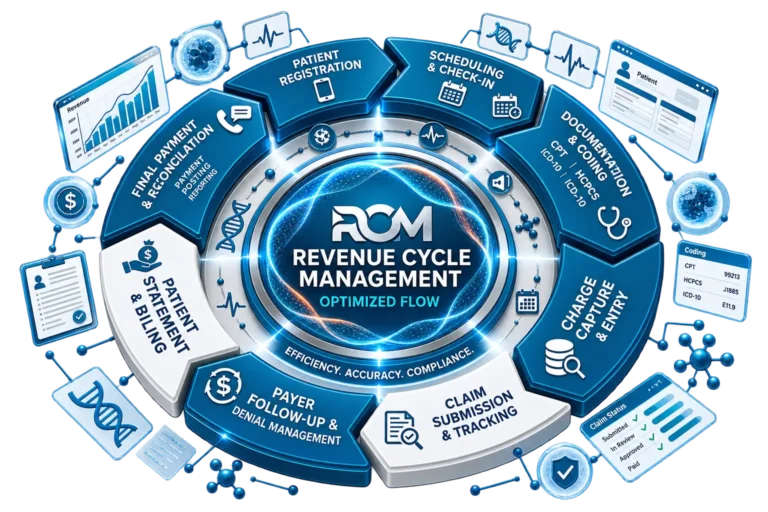
Operating in Alignment With Today's Healthcare Billing Standards
✓ HIPAA ✓ CMS ✓ AMA CPT® ✓ ICD-10-CM ✓ HCPCS Level II ✓ No Surprises Act
Revenue Cycle Management Is Bigger Than Billing
Revenue Starts Before the Claim and Continues Long After It Is Submitted
Billing is one part of the revenue cycle. The financial outcome of a patient encounter can be influenced much earlier, beginning with registration, eligibility, insurance verification, authorization, and documentation. After the claim is submitted, payer responses, denials, A/R follow-up, payment posting, reconciliation, and reporting continue to shape the result.
Medverse delivers RCM services across these connected stages, giving practices one coordinated view of the work that affects reimbursement.
THE REVENUE CYCLE DOESN’T START WITH A CLAIM

PATIENT ACCESS
Registration, demographics, eligibility, and insurance information

CLINICAL & CODING
Documentation, coding, charge capture, and claim preparation

CLAIMS & PAYERS
Claim submission, payer responses, edits, and follow-up

REVENUE RECOVERY
Denials, A/R, underpayments, payment posting, and reconciliation

INSIGHT
Reporting, trends, performance, and opportunities for improvement
Every stage contributes to the financial outcome of the encounter.
AI-Assisted RCM That Helps the Right Work Get Attention
More Visibility Across the Revenue Cycle. More Focus on What Needs Action.
Revenue cycle teams work with large volumes of claims, payer responses, A/R activity, and patient and billing data. AI-assisted technology can help identify patterns, surface potential issues, and bring higher-priority work to the team’s attention. Medverse combines these capabilities with experienced RCM professionals who review the information, determine what requires action, and follow through. Technology helps the team see more. People decide what matters.
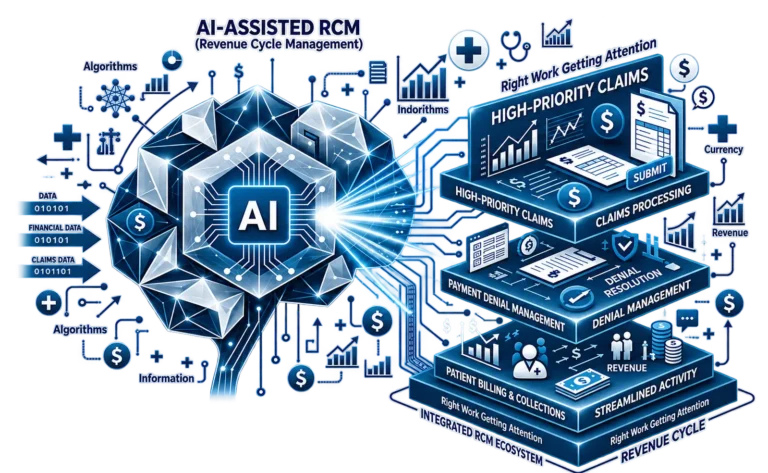
WHERE AI CAN HELP
IDENTIFY
Surface patterns, exceptions, and potential issues across revenue cycle activity.
PRIORITIZE
Bring attention to accounts, claims, and workflows that may require timely intervention.
ANALYZE
Help teams recognize recurring patterns across denials, A/R, payer responses, and reimbursement activity.
SUPPORT
Give experienced RCM professionals more relevant information as they evaluate and act on issues.
AI FINDS THE PATTERNS.
EXPERIENCED TEAMS DECIDE WHAT TO DO WITH THEM.
See Where AI-Assisted RCM Could Help Your Practice
Understand where technology can support your revenue cycle and where experienced people still need to make the call
Every practice has different claim volumes, payer patterns, A/R challenges, and workflow priorities. Tell us a little about your current revenue cycle, and our team can discuss where AI-assisted workflows may help identify issues, prioritize work, and give your RCM team better visibility.
Where Revenue Starts Before a Claim Exists
The Financial Outcome of a Patient Encounter Can Be Shaped Before the First Code Is Entered
A patient encounter can create revenue risk before the claim ever reaches a payer. Inaccurate patient information, inactive coverage, missed authorization requirements, or incomplete charge capture can create problems that surface later as claim edits, denials, delayed payments, or additional administrative work.
Medverse addresses these front-end elements as part of the broader revenue cycle, helping practices establish a stronger foundation before services move into coding and claims.
BEFORE THE CLAIM
PATIENT INFORMATION
Accurate demographics, insurance details, and patient records.
ELIGIBILITY & BENEFITS
Coverage and benefit verification before services are billed.
AUTHORIZATION & REFERRALS
Payer requirements that may affect whether services are reimbursed.
CHARGE CAPTURE
Making sure services provided are captured before coding and claim preparation.
A small detail at the front can become a bigger problem later

When these elements are addressed early, the downstream revenue cycle has fewer avoidable issues to work through.
Revenue protection begins before the claim is created.
Where the Revenue Cycle Can Lose Momentum
Revenue rarely gets disrupted at just one point. A claim can be delayed by an eligibility issue, held up by an authorization requirement, rejected because of a coding or payer rule, or left unresolved after a denial. The longer an issue remains open, the more work it can create downstream.
Medverse looks across the revenue cycle to identify where work is slowing down, why it is happening, and what needs attention next.
WHERE MOMENTUM CAN BE LOST
BEFORE SUBMISSION
Missing information, eligibility problems, authorization gaps, or charge capture issues can prevent a claim from moving forward cleanly.
AT CLAIM SUBMISSION
Coding errors, payer edits, missing requirements, and claim configuration issues can result in rejections or delays.
AFTER PAYER RESPONSE
Denials, underpayments, requests for additional information, and unresolved payer issues can keep revenue from being collected.
INSIDE A/R
Accounts can remain outstanding when follow-up is delayed, payer responses are not addressed, or the next action is unclear.
THE QUESTION IS NOT ONLY “WHAT WENT WRONG?
It is also:
Where did it happen?
How long has it been open?
Why did it happen?
What needs to happen next?
Looking at those questions together helps turn individual billing problems into a clearer view of where the revenue cycle needs attention.
Revenue cycle management is also about knowing where momentum was lost and getting the work moving again.
RCM Performance You Can Actually See
Revenue cycle performance becomes clearer when the numbers show what is happening across the operation
A revenue cycle can generate a large amount of activity without necessarily producing the results a practice expects. Clean claims, reimbursement speed, A/R, and overall claim volume provide a more useful picture when they are viewed together. Medverse tracks the operational measures that help practices understand how their revenue cycle is performing and where attention may be needed.
The Numbers Behind Our RCM Performance
Clean Claim Rate
Faster Reimbursements
Average Days in A/R
Claims Processed Annually
NUMBERS SHOULD LEAD TO BETTER QUESTIONS
Which claims are taking longer to pay?
Which payer patterns deserve attention?
Where are denials occurring most often?
Where is A/R accumulating?
Performance reporting gives the team a starting point. The value comes from understanding what the numbers are telling you and deciding what should happen next.
Better visibility makes it easier to know where your revenue cycle needs attention.
What Are Your Revenue Cycle Numbers Telling You?
A closer look at your billing performance can reveal where revenue is moving well, where it is slowing down, and where your team may need to focus next.
Coding, Claims, and Payer Requirements Work Together
A claim can be coded correctly and still run into a payer requirement that affects reimbursement
Revenue cycle performance depends on more than getting a code onto a claim. The documentation has to support the service, the coding has to accurately represent what was performed, and the claim has to meet the requirements of the payer receiving it.
Medverse brings these considerations together within the RCM workflow, helping teams address issues before submission and respond appropriately when payer requirements affect the outcome.
THREE PARTS OF THE SAME REVENUE DECISION
CODING
CLAIMS
PAYER REQUIREMENTS
WHEN THEY ALIGN, THE CLAIM HAS A STRONGER STARTING POINT.
The relationship matters because an issue in one area can create work somewhere else.
Documentation Issue
Coding Question
Coding Issue
Claim Edit or Rejection
Payer Requirement
Denial or delayed reimbursement
Recurring Payer Issue
A Pattern Worth Investigating
Our RCM teams consider these connections as they manage claims and payer activity, helping practices address problems at the point where they occur rather than treating every issue as an isolated billing event.
The goal is not simply to submit a claim. It is to understand what the claim needs to move through the payer process successfully.
Revenue Cycle Management Changes With the Practice
Your revenue cycle should make sense for the organization behind it
A single provider, a growing group, and a multi-location healthcare organization may all need the same core RCM functions, but the operational demands are very different.
As a practice grows, more providers, locations, payers, specialties, and states can become part of the same revenue operation. The challenge is keeping those moving pieces connected without losing visibility into what is happening at each level.
FROM ONE PRACTICE TO A MORE COMPLEX OPERATION
01
INDEPENDENT PRACTICE
- Provider activity
- Patient volume
- Payer relationships
- Billing workflow
02
GROUP PRACTICE
- Multiple providers
- Different provider activity
- Shared payer relationships
- Greater billing volume
03
MULTI-LOCATION PRACTICE
- Location-level activity
- Provider affiliations
- Payer participation
- Cross-location visibility
04
MULTI-STATE ORGANIZATION
- State-specific considerations
- Multiple locations
- Expanded payer relationships
- Greater operational complexity
WHAT CHANGES AS YOU GROW?
MORE PROVIDERS
MORE LOCATIONS
MORE PAYERS
MORE SPECIALTIES
ONE REVENUE CYCLE. A DIFFERENT OPERATING ENVIRONMENT.
Medverse provides revenue cycle management services for practices at different stages of growth, adapting RCM workflows around the structure, services, payer environment, and operational priorities of each organization.
The objective is not to make every practice fit the same model. It is to provide the visibility, expertise, and follow-through needed for the revenue cycle you actually operate.
As the practice changes, the revenue cycle has to change with it.
Let’s Talk About Your Practice
Tell us how your practice is structured. We’ll help you identify the RCM support that fits
Revenue cycle requirements can change as practices grow, add providers, or expand across locations. Share a few details about your organization, and our team can discuss the operational considerations that matter for your practice.
WHAT BEST DESCRIBES YOUR PRACTICE?
When a Claim Does Not Pay, the Work Continues
A claim can leave the billing system as a completed submission and still come back with a very different outcome
It may be denied.
It may remain unpaid longer than expected.
It may be underpaid.
It may require information the payer did not have.
What matters then is not simply that the claim did not pay. The next question is why.
ONE UNPAID CLAIM CAN LEAD IN SEVERAL DIRECTIONS
A DENIAL
AN UNDERPAYMENT
AN OUTSTANDING BALANCE
A PAYER REQUEST
THE ACCOUNT DOESN'T DISAPPEAR AFTER THE FIRST RESPONSE
Our RCM teams review what happened, determine the appropriate response, and continue working the account based on its circumstances.
- Some claims need correction and resubmission.
- Some require an appeal.
- Some require documentation.
- Some require continued payer follow-up.
The approach depends on the reason payment did not occur as expected.
The work continues until there is a clear outcome: payment, appropriate resolution, or a documented reason the account cannot be recovered.
BEHIND EVERY UNPAID CLAIM IS A QUESTION WORTH ANSWERING.
Why didn't it pay?
What can be done about it?
Who needs to act?
What happens next?
That is where revenue recovery becomes more than account follow-up. It becomes an ongoing effort to understand the payer response, act on the issue, and protect the revenue that remains outstanding.
Compliance Is Built Into the Revenue Cycle
Every stage of the revenue cycle operates within a set of requirements that can affect how information is handled, services are documented, claims are coded, and reimbursement is pursued.
Medverse incorporates applicable requirements throughout its RCM workflows, with attention to HIPAA, CMS requirements, CPT®, ICD-10-CM, HCPCS Level II, documentation, medical necessity, and payer-specific billing requirements.
THE STANDARDS BEHIND THE WORK

HIPAA
Patient information and protected health information must be handled appropriately throughout the revenue cycle.
CMS Requirements
Applicable Medicare and Medicaid requirements can influence billing, documentation, coding, and reimbursement.

CPT®, ICD-10-CM & HCPCS LEVEL II
Accurate code selection and reporting provide the foundation for communicating services and diagnoses on claims.

DOCUMENTATION & MEDICAL NECESSITY
The services reported should be supported by the clinical record and meet applicable medical necessity requirements.

PAYER-SPECIFIC REQUIREMENTS
Health plans may apply their own coverage policies, billing rules, authorization requirements, and claim edits.
The objective is to keep these considerations connected to the work as it happens, rather than treating compliance as a final checkpoint after the revenue cycle is complete.
Compliance belongs inside the process, not at the end of it.
Are Your RCM Processes Aligned With the Requirements Behind Them?
Let’s look at the billing, coding, documentation, and payer requirements that affect your revenue cycle
Tell us about your practice and the areas you’re concerned about. Our team can discuss the RCM requirements relevant to your operation and help identify where additional attention may be needed.
Technology That Connects the Revenue Cycle
The revenue cycle generates information at every stage. The real value comes from keeping that information connected
A patient encounter creates data. A claim creates status and payer responses. A denial creates a reason for intervention. A payment creates another set of financial information. When these pieces remain connected, teams can see more than an individual transaction.
FROM ENCOUNTER TO REVENUE
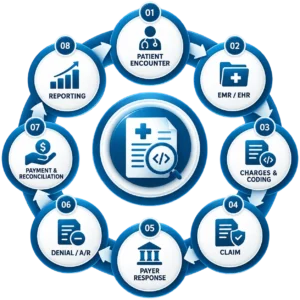
The technology supporting the revenue cycle helps keep these stages connected, giving teams access to the information they need without treating each stage as a separate operation.
ONE PIECE OF INFORMATION CAN TELL A MUCH LARGER STORY.
- A denial may point back to a coding issue.
- A slow payment may reveal a payer pattern.
- An A/R balance may reflect an earlier workflow problem.
- A recurring claim issue may indicate a process that needs attention.
Technology helps connect those signals across the revenue cycle so the team can investigate the bigger picture.
Connected systems create connected visibility.
And when information is easier to follow from the original encounter through the final payment, RCM teams can spend less time searching for what happened and more time deciding what to do about it.
What Happens When the Numbers Tell a Different Story?
A revenue cycle can look healthy at first glance.
- Claims are being submitted.
- Payments are coming in.
- A/R is being worked.
But the numbers can tell a different story when they are viewed together.
- A rising denial rate may point to a recurring payer or coding issue.
- Growing A/R may signal that follow-up is not keeping pace.
- Slower reimbursement may reveal a problem that began much earlier in the cycle.
- A change in payment patterns may deserve a closer look.
THAT IS WHERE THE NUMBERS BECOME USEFUL
Medverse uses revenue cycle data to look beyond individual accounts and identify patterns across claims, payers, denials,
A/R, reimbursement, and payment activity.
The objective is not to produce more reports.
It is to recognize what is changing, where it is happening, and whether something needs to be addressed.
A number shows what happened. A pattern can help explain why.
From Data to Action
Reporting only becomes valuable when someone knows what to do with it
Revenue cycle data can show where claims are slowing down, which payers are generating more denials, where A/R is accumulating, or how reimbursement is changing. But identifying a pattern is only the beginning.
The next step is deciding whether the pattern requires investigation, intervention, or simply continued monitoring.
WHAT THE DATA CAN CHANGE
A RISING DENIAL PATTERN
AGING A/R
CHANGING REIMBURSEMENT
RECURRING WORKFLOW ISSUES
SEE IT. UNDERSTAND IT. ACT ON IT.
Medverse brings reporting and operational RCM work together so that insights can move beyond a dashboard and into the day-to-day decisions that affect the revenue cycle.
The goal is not more data. It is better decisions based on the data you already have.
What Could a Closer Look at Your Revenue Cycle Reveal?
An RCM assessment can help identify where revenue is performing well, where it is slowing down, and where operational changes may make a difference.
Tell us a little about your practice and what you’re seeing in your revenue cycle. Our team can review the areas that matter most to your operation and discuss where a closer assessment may be valuable.
Good Work Is Measured by the People You Support
Hear from healthcare teams about their experience with us
Every practice has different needs. Our clients share what they value about the people, expertise, and support behind their experience with Medverse.




“I wanted more than another monthly spreadsheet. I wanted to understand whether our billing process was improving and where we still had exposure. The conversations with Medverse are much more focused on those questions.”
Michelle Davenport Director of Finance, Independent Medical Group“We had a habit of dealing with revenue cycle problems after they became urgent. Medverse has helped us look further upstream, particularly at the information coming from registration, documentation, and claim preparation. That perspective has been valuable.”
Scott Anderson Chief Operating Officer, Ambulatory Care Organization“The A/R discussions are much more productive now. Instead of looking at one large outstanding balance, we're talking about which accounts are actionable, which ones need payer follow-up, and where an underlying process needs to change.”
Teresa Franklin Revenue Cycle Director, Regional Physician Practice“As an owner, I need to understand cash flow without getting buried in every transaction. Medverse gives us a way to review the larger picture while still being able to drill into individual issues when necessary. That's the level of visibility I was looking for.”
Dr. David Kim Physician Owner, Outpatient Medical GroupWhen Revenue Gets Stuck, We Find Where It Happened
Revenue problems often become visible at the end of the cycle
- A balance remains in A/R.
- A payment comes in lower than expected.
- A claim is denied.
But the point where the problem becomes visible is not always where it began.
FOLLOW THE REVENUE BACK
A/R BALANCE
An account remains outstanding longer than expected.
PAYER RESPONSE
The claim reveals a denial, underpayment, request for information, or another unresolved issue.
CLAIM DETAIL
The team looks closer at the codes, modifiers, claim information, and payer requirements involved.
DOCUMENTATION
The review may lead back to what was documented, how the service was represented, or whether the record supports the claim.
FRONT-END ACTIVITY
Eligibility, authorization, referrals, patient information, or charge capture may reveal where the issue originally entered the revenue cycle.
THE END OF THE CYCLE CAN REVEAL THE BEGINNING OF THE PROBLEM
That perspective matters because treating every unpaid account as an A/R problem can leave the underlying cause untouched.
Medverse looks beyond the immediate account to understand what happened across the revenue cycle, identify recurring causes, and help address issues where they actually begin.
Find the problem. Trace it back. Fix what keeps repeating.
Let’s Take a Closer Look at Your Revenue Cycle
Tell us where your revenue cycle stands today. We’ll help you identify where the right support could make a difference
Every practice has its own combination of providers, specialties, payers, workflows, and revenue challenges. Whether you need comprehensive revenue cycle management services or help addressing a specific area, our team can learn how your operation works and discuss the opportunities that may be worth exploring.
“It's easy to look at collections and assume that tells you everything about the financial health of a practice. Medverse helped us pay closer attention to aging receivables, denial trends, and the reasons certain claims weren't getting paid. Those details are important when you're making operating decisions.”
Edward Lawson Chief Financial Officer, Multispecialty Physician Group