

Cardiology Billing Services for Complex Cardiovascular Care
Specialty Billing. Precise Coding. Payer Expertise. AI-Assisted Workflows.
Medverse provides specialized billing support for cardiologists, cardiology groups, and cardiovascular practices. Our billing teams understand the coding, documentation, diagnostic testing, procedure, and payer requirements that shape cardiology reimbursement. AI-assisted workflows help identify billing patterns and prioritize work, while experienced billing professionals manage the decisions that require clinical and billing expertise.

Operating in Alignment With Today's Healthcare Billing Standards
✓ HIPAA ✓ CMS ✓ AMA CPT® ✓ ICD-10-CM ✓ HCPCS Level II ✓ No Surprises Act
Cardiology Billing Has More Moving Parts Than the Claim
A cardiology encounter can move through several billing decisions before it ever becomes a claim
✓ Evaluation
Office visits, consultations, and follow up encounters establish the clinical work performed and the appropriate E/M reporting.
✓ Diagnostic Testing
ECGs, echocardiography, stress testing, and other cardiovascular studies introduce their own coding and medical necessity considerations.
✓ Interpretation
Professional interpretation of diagnostic studies may involve separate reporting requirements depending on the service and billing circumstances.
✓ Procedure
Cardiovascular procedures can bring additional coding, modifier, bundling, and global-period considerations.
✓ Follow-Up
Post-procedure and subsequent visits may require different billing treatment depending on the service and circumstances.
✓ Ongoing Management
Chronic cardiovascular conditions can involve recurring visits, medication management, monitoring, and continued care that must remain accurately represented over time.
A single encounter may include several of these elements. They do not automatically translate into separately reportable claim lines. What can be reported depends on the circumstances, documentation, coding rules, and payer requirements.
One clinical encounter can create multiple billing decisions.
AI-Assisted Billing Intelligence for Cardiology
Finding the Billing Patterns Hidden in High-Volume Cardiology Work
Cardiology billing can produce a large volume of activity across office visits, diagnostic testing, procedures, and follow-up services. Within that activity, important patterns can be difficult to spot when teams are reviewing claims and accounts individually.
AI-assisted billing workflows can help surface those patterns so experienced billing professionals can focus their attention where it matters most.

Recurring Denial Patterns
Identify repeated denial trends across services, payers, providers, or locations.

Unusual Coding Combinations
Flag billing activity that differs from expected patterns and may warrant closer review.

Payer-Specific Reimbursement Patterns
Surface recurring differences in denials, payment behavior, claim edits, or reimbursement.

High-Value A/R
Help prioritize accounts where follow-up may have greater financial impact.

Underpayment Patterns
Identify payment activity that may indicate recurring reimbursement variances.

Provider & Location Activity
Compare billing and reimbursement patterns across providers, locations, or service types.

Claims Requiring Review
Bring exceptions and unusual activity to the attention of billing professionals responsible for evaluating them.
AI Identifies the Pattern. Experienced Professionals Decide What It Means.
AI can help make large volumes of billing data easier to analyze, but it does not replace the judgment required to evaluate documentation, coding, payer requirements, or individual claim circumstances.
The technology helps find where to look. Experience determines what to do next.
What Is Your Cardiology Billing Data Telling You?
Denials, payment variances, A/R, and claim activity can reveal patterns that are difficult to see one account at a time. Our team can help you identify where those patterns may be affecting your revenue cycle.
Billing Expertise Across the Cardiology Care Continuum
From the first evaluation to advanced procedures and ongoing cardiac management, cardiology billing requires an understanding of how each service fits into the larger episode of care
Medverse provides cardiovascular billing services across the care continuum, with attention to coding, documentation, medical necessity, payer requirements, and how related services interact on the claim.
Evaluation & Management
Office visits, consultations, and follow-up encounters require accurate representation of the clinical work, patient history, medical decision-making, and level of service supported by the documentation.
Cardiac Catheterization & Coronary Angiography
Catheterization and coronary angiography require precise procedure coding, diagnosis linkage, vessel-specific reporting where applicable, and careful attention to payer and coding requirements.
Electrocardiography
ECG services involve more than selecting the appropriate procedure code. Billing may depend on the service performed, interpretation, documentation, and whether the ECG is reported alongside another diagnostic service.
Interventional & Procedural Cardiology
Complex cardiovascular procedures can involve multiple services, modifiers, bundling and edit considerations, and global surgery rules. Each claim needs to reflect what was actually performed and documented.
Echocardiography
Transthoracic, Doppler, and related echocardiographic services can involve distinct coding and reporting considerations, including medical necessity, documentation, interpretation, and applicable component billing.
Vascular Services
Cardiology practices may also bill vascular diagnostic and procedural services, creating additional coding, medical necessity, and payer considerations within the revenue cycle.
Cardiovascular Stress Testing
Exercise and pharmacological stress testing can involve multiple related services. Accurate billing requires understanding which components are included, which may be separately reportable, and what documentation supports the study.
Cardiac Rehabilitation
Rehabilitation services bring their own documentation, diagnosis, coverage, and ongoing treatment considerations that must be reflected accurately in the billing workflow.
Rhythm & Monitoring Services
Holter monitoring, ambulatory rhythm monitoring, and related services introduce additional considerations around monitoring, analysis, interpretation, and reporting.
Follow-Up & Ongoing Management
Cardiac care often continues well beyond the initial encounter. Follow-up visits, chronic condition management, medication-related care, and ongoing monitoring require consistent billing practices across the patient's course of care.
Different services create different billing decisions. The expertise is knowing how those decisions connect.
Cardiology Coding Requires More Than Selecting a CPT® Code
The procedure code is only one part of the billing decision. Accurate cardiology coding depends on how the service was performed, why it was performed, what the documentation supports, and how related services interact on the claim.
A cardiology claim can bring together procedure coding, diagnosis linkage, modifiers, NCCI edits, global surgery rules, component reporting, and payer-specific requirements. Each element needs to support the others.
CPT® SELECTION
PROFESSIONAL & TECHNICAL COMPONENTS
ICD-10-CM DIAGNOSIS LINKAGE
DOCUMENTATION
NCCI EDITS
MEDICAL NECESSITY
MODIFIER APPLICATION
SEPARATE REPORTING OF SERVICES
GLOBAL SURGERY RULES
ADD-ON CODES
The Question Is Not Just “What Code Was Used?”
It is whether the complete claim tells the same story as the clinical record.

When those elements align, the claim has a stronger foundation before it ever reaches the payer.
Let’s Look at the Coding Behind Your Cardiology Claims
Every cardiology practice has its own providers, services, payer relationships, and operational priorities. Tell us a little about your practice and what you would like to improve, and our team can discuss where Medverse may be able to help.
Diagnostic Testing Is Its Own Billing Environment
A diagnostic study does not become a clean claim simply because the test was performed correctly
In cardiology, the billing decision can depend on the clinical reason for the study, the documentation supporting it, how the service was performed and interpreted, whether related services occurred during the same encounter, and what the payer requires.
From Clinical Indication to Reimbursement
01 — Clinical Indication
Why is the patient being tested? The record needs to establish the clinical circumstances that support the diagnostic service.
02 — Test Selection
The reason for choosing an ECG, echocardiogram, stress test, stress echocardiogram, or rhythm monitoring service can affect the documentation and medical-necessity requirements that follow.
03 — Documentation
The medical record needs to support the service reported. Depending on the study, this may include the clinical indication, relevant findings, interpretation, and other required documentation.
04 — Interpretation & Reporting
The billing workflow needs to account for the service performed, interpretation, and professional or technical components where applicable.
05 — Related Services
When multiple diagnostic services occur during the same encounter, they do not automatically become separately reportable. Coding edits, bundling rules, and the circumstances of the encounter have to be considered.
06 — Payer Review
Medical necessity, coverage policies, coding requirements, and payer-specific rules ultimately influence how the claim is evaluated.
Consider Cardiovascular Stress Testing
CMS guidance illustrates why the details matter. Documentation for cardiovascular stress testing may need to substantiate the medical necessity of the study, the clinical reason for testing, and, where applicable, why a particular approach such as stress echocardiography or pharmacological stress was selected.
The relationship between diagnostic services can matter as well. For example, CMS provides specific guidance for ECG services performed on the same day as cardiovascular stress testing, including circumstances in which an ECG may be separately payable when it is not part of the stress test and provides additional information relevant to the patient’s care.
The test is only the starting point. The billing outcome depends on how the clinical indication, documentation, reporting, coding, and payer requirements come together.
When Procedures, E/M Services, and Global Periods Intersect
One cardiology encounter can involve evaluation, decision-making, and a procedure. That does not automatically make every service separately reportable.
Consider a patient who presents with a cardiac condition, receives an evaluation, and undergoes a procedure during the
same encounter. The billing decision depends on what work was performed, whether the E/M service was separately iden
tifiable, whether the procedure has a global surgical period, and what the documentation supports.
The Clinical Encounter Is Only the Beginning
The same-day picture may include:
Evaluation & Management
The physician evaluates the patient, assesses the condition, and determines the appropriate course of treatment.
Procedure
A cardiovascular procedure is performed based on the patient's clinical needs.
Postoperative Care
After a procedure, subsequent services may fall within the applicable global surgical period rather than being separately reported.
The key question is not simply whether each service occurred. It is whether the billing rules allow each service to be reported separately under the circumstances.
Where Modifier 25 Comes Into the Picture
An E/M service may be separately reportable with a procedure when the documentation supports a significant, separately identifiable E/M service beyond the work inherent in the procedure itself.
Modifier 25 communicates that distinction. It should reflect the actual circumstances of the encounter and the work documented, rather than being applied simply be cause an E/M service and procedure occurred on the same date.
When Modifier 57 May Apply
The timing and nature of the E/M service can matter when a decision is made to perform a major procedure. Modifier 57 may apply in circumstances where the E/M service represents the decision for surgery, subject to the applicable global surgery rules and documentation requirements.
Global Periods Change What Happens After the Procedure
A procedure with a global surgical period can affect how related postoperative services are reported. Follow-up care that is included in the global package is generally treated differently from a service that meets the requirements for separate reporting.
This is where procedure coding, global-period rules, documentation, and the circumstances of the postoperative encounter have to be considered together.
The Documentation Has to Tell the Same Story
A modifier cannot create a separately reportable service that the record does not support.
For cardiology practices, the billing review may need to determine:
- What evaluation or decision-making occurred?
- What work was integral to the procedure?
- Was the E/M service separately identifiable?
- Was the service performed before, during, or after a procedure?
- Does a global surgical period apply?
- Does an NCCI edit affect the code combination?
- Does the documentation support the modifier and the reported services?
The goal is not to report more services. It is to report the services that the clinical record and applicable billing rules support.
Medical Necessity Can Determine Whether the Service Gets Paid
Accurate coding cannot compensate for a service that is not adequately supported
Medical necessity connects the clinical reason for a service to the claim submitted to the payer. When that connection is incomplete, even correctly coded services can face coverage questions, additional documentation requests, or denials.
From Clinical Indication to Payer Coverage
01
Clinical Indication
Why is the service needed?
02
Service Performed
What was actually provided?
03
Documentation
Does the medical record support the service?
04
ICD-10-CM
Does the diagnosis support the reported service?
05
Payer Coverage
Does the payer recognize the service for the documented circumstances?
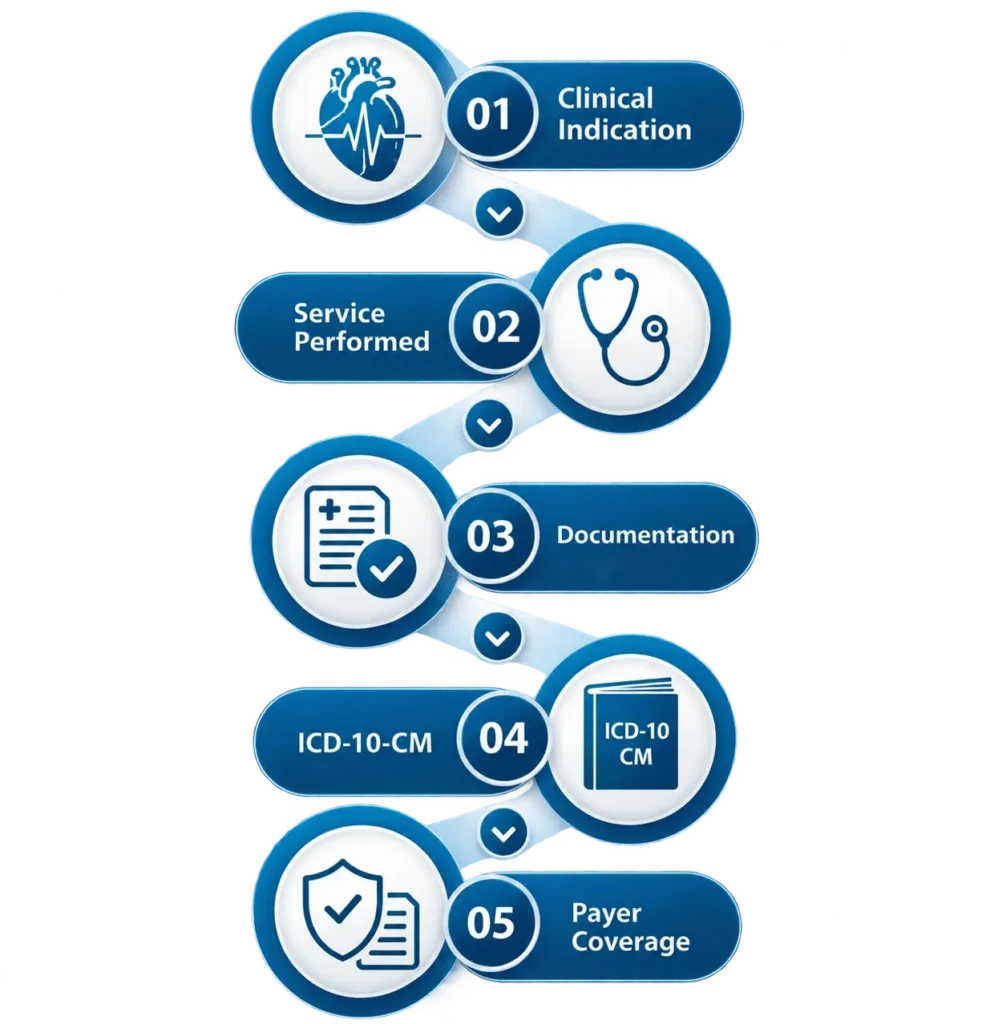
The Claim Has to Carry the Clinical Reasoning Forward
A diagnosis should not simply be selected to accompany a procedure code. The clinical indication, service performed, documentation, diagnosis, and applicable coverage requirements need to tell a consistent story.
CMS guidance for cardiovascular stress testing illustrates this connection. Documentation must support medical necessity and the clinical reason for the study, with additional information required in certain circumstances to support the selected testing approach.
A code can describe the service. It cannot create the clinical justification for performing it.
Turning Cardiology Billing Data Into Action
Billing data becomes more valuable when it helps your team decide where to look next
A cardiology revenue cycle can generate thousands of claims, payments, adjustments, and follow-up activities. Medverse helps practices identify patterns across denials, reimbursement, A/R, payer behavior, providers, and locations so billing teams can focus on the issues that deserve attention.
THE NUMBERS BEHIND THE OPERATION
Claims Accuracy Rate
Cardiology Coding Accuracy
Medical Necessity Denial Rate
Underpayment Recovery Rate
WHAT SHOULD THE DATA MAKE YOU ASK?
- Which procedures generate recurring denials?
- Which payers create the most reimbursement friction?
- Where is A/R aging?
- Are underpayments concentrated around specific procedures?
- Are authorization issues affecting certain services?
The goal is not simply to report the numbers. It is to understand what they reveal about the billing operation and determine where action may be needed.
The numbers show where to look. The analysis determines what to do next.
Take a Closer Look at Your Cardiology Billing
Review your billing data with our team and identify where your revenue cycle may have opportunities for improvement.
Payer Rules Change the Billing Environment
The same cardiology service can face different requirements depending on the payer and plan
Medicare, Medicare Advantage, Medicaid, and commercial plans can differ in coverage policies, medical necessity criteria, authorization requirements, network participation, documentation, claim edits, and reimbursement.
For cardiology practices, payer expertise means knowing which requirements apply before a claim reaches the payer.
ONE SERVICE. DIFFERENT PAYER QUESTIONS.
Coverage
Is the service covered for this diagnosis and clinical circumstance?
Documentation
Does the record support the payer's requirements?
Authorization
Was prior authorization required?
Reimbursement
Will the service be processed and paid according to the applicable plan rules?
These differences can affect diagnostic testing, procedures, follow-up care, and recurring services throughout the revenue cycle.
The service may be the same. The billing requirements may not be.
Your Existing EMR/EHR. Our Billing Expertise.
Your technology does not need to change for your billing operation to improve
Cardiology practices often have established clinical, diagnostic, scheduling, and documentation workflows within their existing EMR/EHR and practice-management systems. Medverse works within that environment rather than making technology replacement a prerequisite for billing support.
Our team adapts the billing workflow around the systems your practice already uses, helping connect clinical documentation, charge information, claims, A/R, and reporting without disrupting the technology your staff already knows.
Keep your systems. Add billing expertise.
EMR/EHR & Practice Management Systems















Keep Your Technology. Strengthen Your Billing.
Your practice can keep the systems your team already knows while adding specialized cardiology billing expertise
Tell us which EMR/EHR or practice-management environment you use and where your billing workflow needs support. We can discuss how our team can work within your existing setup.
Cardiology Billing Has to Scale With the Practice
The billing environment changes as provider volume, services, locations, and payer relationships become more complex
An independent cardiologist, a multi-physician group, and a procedure-focused organization can have very different billing priorities. Medverse adapts its billing services to the way each practice operates.
WHAT CHANGES AS THE PRACTICE CHANGES?
Independent Cardiology Practice
Focused provider volume and a smaller footprint often make claim accuracy, reimbursement, A/R, and cash flow visibility central priorities.
Multi-Physician Cardiology Group
More providers and varied service volumes increase the need for provider-level reporting, coding consistency, A/R oversight, and performance visibility.
Multi-Location Cardiology Organization
Multiple locations add provider, payer, A/R, and reporting variables that need to remain aligned across the organization.
Interventional & Procedure-Focused Practice
Higher procedural volume can bring greater coding complexity, authorization requirements, reimbursement variation, and professional/facility billing considerations.
The billing solutions should fit the practice, its services, and the way care is delivered.
A Diagnostic Test Keeps Getting Denied. The Problem May Not Be the Claim.
A recurring denial is often a signal to trace the billing workflow backward
A cardiology diagnostic claim can fail for reasons that begin before coding or claim submission. If the same service keeps encountering the same payer response, reviewing the claim line by line may not be enough.
TRACE THE PROBLEM BACKWARD
ORDER
Was the diagnostic study ordered for a documented clinical reason?
MEDICAL NECESSITY
Does the diagnosis and clinical indication support the service under the applicable payer policy?
DOCUMENTATION
Does the record contain the information needed to support the service and its medical necessity?
CODING
Does the reported code accurately represent the service performed?
MODIFIER / COMPONENT
Are applicable modifiers, professional or technical components, and related services being reported correctly?
PAYER
Does the payer or plan have additional coverage, authorization, or claim-processing requirements?
CLAIM
Only after those elements align does the submitted claim tell a consistent story.
THE DENIAL MAY BE THE SYMPTOM, NOT THE ROOT CAUSE.
If the same diagnostic service keeps getting denied, the right question may not be “How do we fix this claim?”
It may be “Where in the workflow does this problem begin?”
Recurring denials deserve a workflow review, not just another resubmission.
The People Behind the Process
A Billing Partnership Built on Expertise, Communication, and Follow-Through
Cardiology practices need more than accurate claims processing. They need a billing team that understands the complexity of their services, communicates clearly, takes ownership of unresolved issues, and remains accessible when questions arise. That combination of specialty knowledge and dependable support makes a difference in the day-to-day working relationship.
Here's what our clients have to say about working with Medverse.




“Our practice performs echocardiograms and other cardiac diagnostic testing, so documentation and code selection are constant areas of attention. I've appreciated the thoughtful questions from Medverse when a report needs clarification.”
Dr. Caroline Davis Medical Director, Outpatient Cardiology Clinic“Modifier questions can create some interesting discussions in cardiology billing. What I value is having someone willing to look at the actual service and documentation instead of automatically applying the same answer to every claim.”
Steven Brooks Certified Professional Coder, Cardiovascular Practice“We were looking for a billing partner who understood the difference between professional services and the technical components of diagnostic testing. That knowledge was important to us, and it made the initial transition conversations much more productive.”
Margaret Sullivan Practice Administrator, Cardiovascular Diagnostic Center“Medical necessity requirements are one of those things you can't afford to overlook with cardiac testing. Medverse has been attentive to the relationship between clinical documentation, diagnosis coding, and the payer's coverage expectations.”
Dr. Benjamin Clarke Noninvasive Cardiologist, Independent Heart Clinic“The part I appreciate is the follow-through on complicated claims. A cardiology denial isn't always resolved by sending the same information again. Sometimes you need to understand the procedure, review the payer policy, and put together a more complete response.”
Jillian Farley Revenue Cycle Supervisor, Cardiology Group Practice“Our cardiologists are busy enough without spending time trying to interpret insurance processing issues. Medverse helps keep those questions moving through the billing team while bringing the physicians in when clinical clarification is actually needed.”
Paul Richardson Chief Administrative Officer, Outpatient Cardiovascular GroupTell Us Where Your Cardiology Workflow Needs Support
Whether your practice is managing high procedure volume, multiple providers, complex payer requirements, or growing A/R, the right billing support starts with understanding how your operation functions today.
Start the conversation by sharing a few details about your practice and the areas where effective billing services could make the greatest difference.
“Cardiology coding isn't something you can manage with a general checklist. Between office visits, diagnostic studies, and procedures, there are a lot of details that have to be right. Medverse understands the importance of reviewing those details before billing.”
Dr. Andrew Mitchell Interventional Cardiologist and Practice Partner